





31 May , 14:59
0
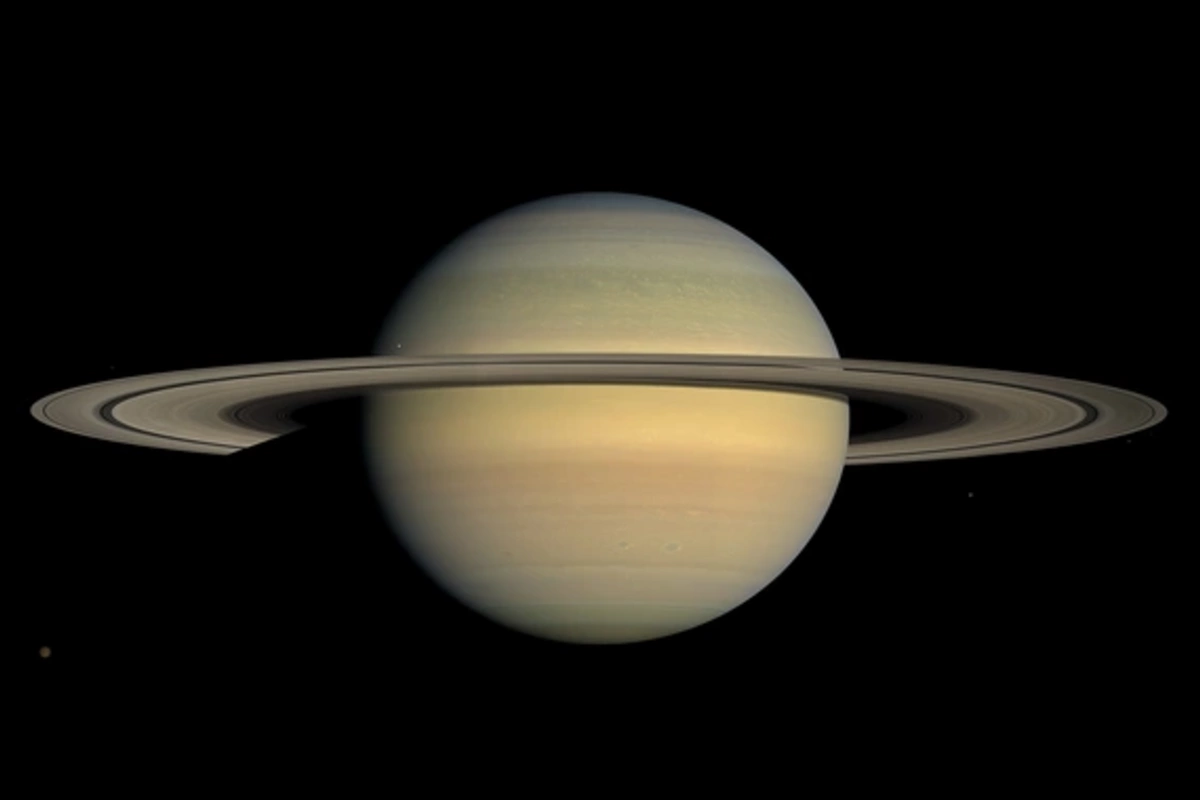
Scientists have for the first time traced in detail how auroras on Saturn affect the planet's atmosphere and create the illusion of changes in its rotation speed. The study, conducted using the James Webb Space Telescope, has solved a mystery that had puzzled astronomers for decades. The results have been published in the Journal of Geophysical Research: Space Physics (JGRSP).
It all began in 2004, when the Cassini spacecraft transmitted data to Earth that literally baffled the scientific community. The measurements indicated that Saturn's rotation speed was changing over time. This seemed extremely unusual: planets are simply not capable of noticeably speeding up or slowing down over such short periods of time.
In 2021, a team of researchers led by Tom Stallard from Northumbria University proposed an explanation. It turned out that it was not the planet's rotation itself that was changing, but the electrical signals associated with the auroras. These were being affected by winds in the upper layers of the atmosphere, causing the rotation speed calculations to be distorted. However, the nature of these mysterious winds remained unknown.
To get to the bottom of the phenomenon, the scientists turned to the James Webb Telescope. It continuously observed Saturn's northern aurora over the course of a full Saturnian day. The researchers analyzed the infrared emission of the H₃⁺ ion — a molecule that serves as a temperature indicator in the gas giant's upper atmosphere.
The new observations turned out to be approximately ten times more precise than all previous measurements. They made it possible to compile the most detailed maps to date of temperatures and the distribution of charged particles in the auroral region. It was precisely thanks to this that scientists discovered localized zones of heating and cooling in the atmosphere for the first time.
The analysis revealed a clear mechanism: energy arriving during auroras heats specific areas of the atmosphere. The resulting temperature contrast triggers winds that generate electric currents. These currents, in turn, sustain the auroras themselves, forming a closed self-sustaining cycle.
"Essentially, what we are observing is a planetary heat pump. The auroras heat the atmosphere, the atmosphere creates winds, the winds generate currents that feed the auroras. The system sustains itself," Stallard explained.
According to the authors of the study, the discovery has significance far beyond the study of Saturn. It demonstrates that a planet's atmosphere and magnetosphere can be tightly interconnected and constantly exchanging energy. The researchers suggest that similar processes may occur on other planets — both within the Solar System and beyond it.