







19 Mar , 22:51
0
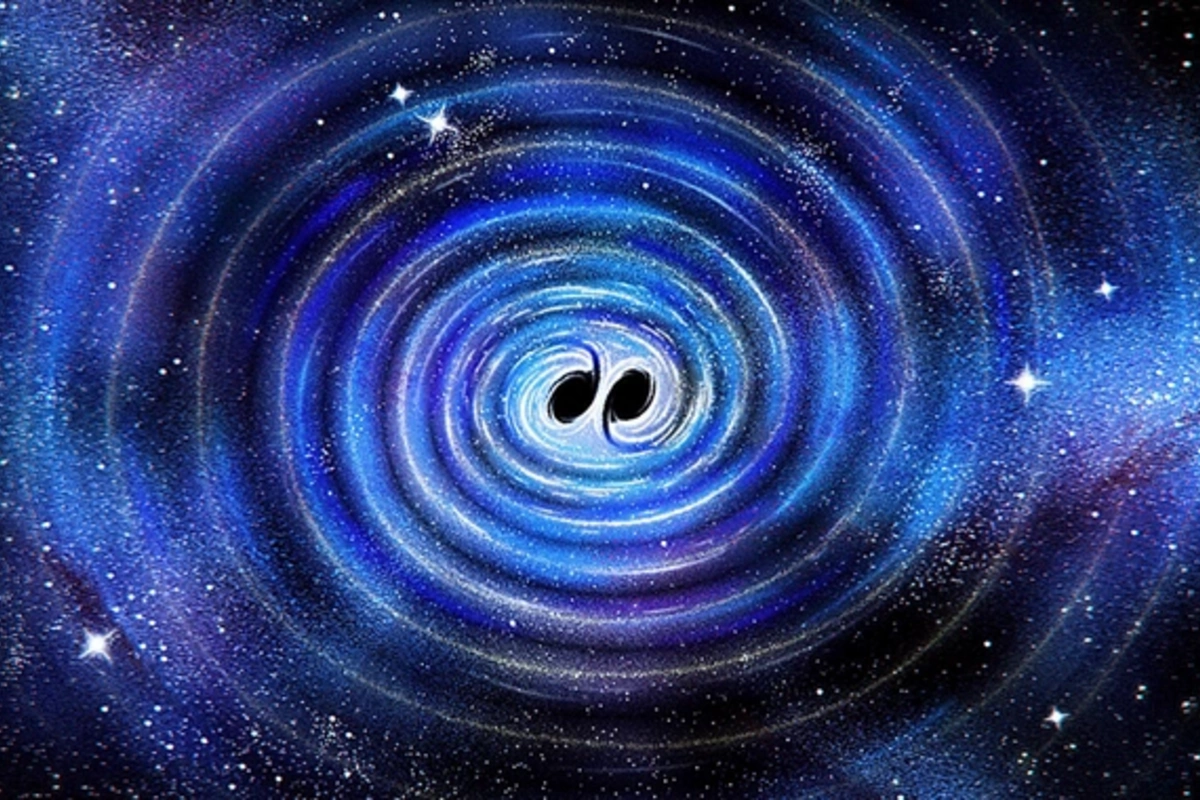
An international team of astronomers has recorded an unusual cosmic event: the merger of two black holes that was likely accompanied by a burst of X-ray and gamma-ray radiation. The work has been published in The Astrophysical Journal Letters (AJL).
On November 25, 2024, the LIGO–Virgo–KAGRA gravitational wave detectors picked up a powerful signal from the depths of the Universe — two black holes collided approximately 4.2 billion light-years from Earth. The result was a true cosmic giant with a mass roughly 150 times that of the Sun.
But the main surprise awaited scientists just 11 seconds later: telescopes captured a burst of X-ray and gamma-ray radiation from the same region of the sky. The researchers estimated the probability of a random coincidence as negligibly small — approximately one such occurrence per decades of continuous observation.
Why is this so important? Black hole mergers have traditionally been considered "dark" events — they do not emit light, since all processes are securely hidden behind the event horizon. The detection of a possible light signal from such a collision came as a genuine surprise to the scientific community.
A team led by astronomer Shu-Rui Zhang from the University of Science and Technology of China proposed an explanation: the collision may have occurred inside the accretion disk of a supermassive black hole — in an active galactic nucleus.
In such regions, space is filled with hot gas and dust. If two black holes merge in such an environment, the resulting object can receive a powerful "kick" and begin moving through the dense material. This triggers intense matter accretion and the formation of narrowly directed streams — jets — which generate the bright radiation.
Computer simulations confirmed that such a scenario can explain the characteristics of the observed gamma-ray burst, which differs notably from typical flares that occur during supernova explosions or neutron star mergers.
The authors emphasize that their hypothesis requires further verification. In particular, it is necessary to refine the orbital parameters of the merging objects and conduct deeper observations of the source galaxy.