







25 Dec , 21:36 2025
12
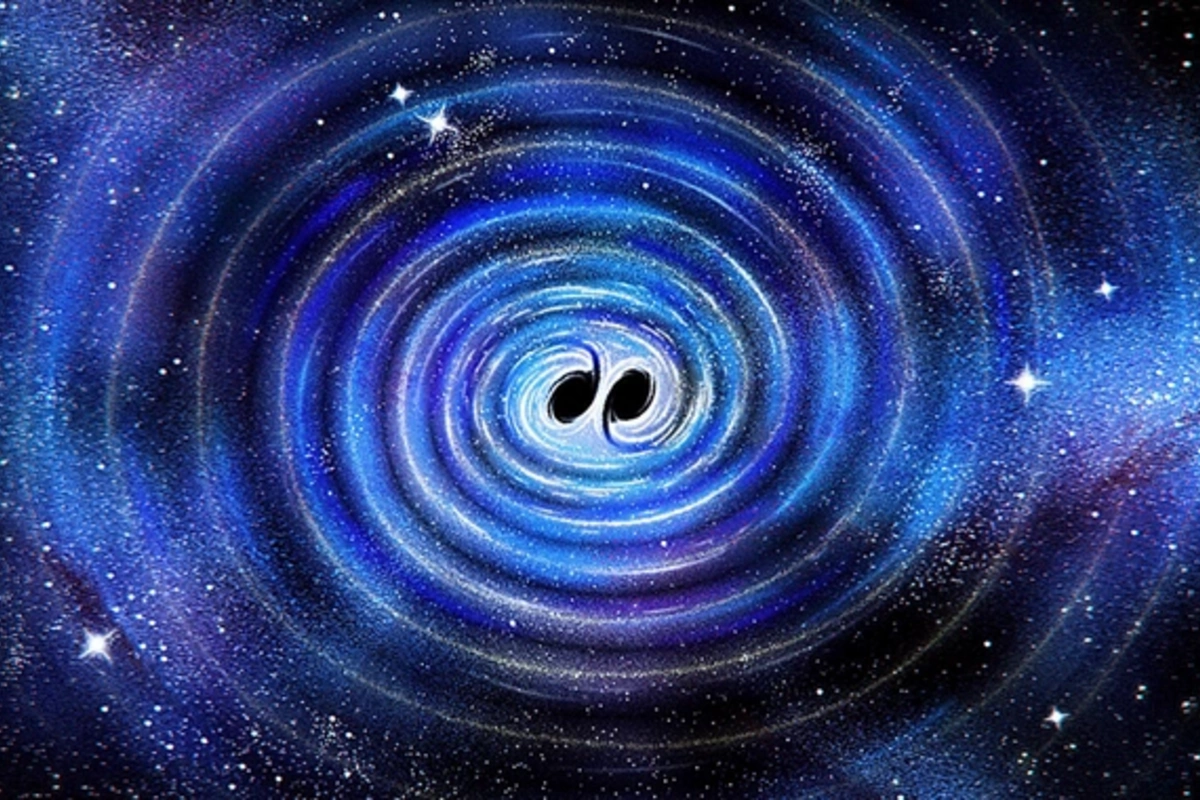
Astrophysicists created unprecedentedly accurate simulations of stellar-mass black holes "feasting"
An international team of scientists has presented revolutionary computer models of the process of matter absorption by stellar-mass black holes. The results of the study, published in the prestigious journal The Astrophysical Journal, are striking in their detail and realism.
The vicinity of black holes has long been considered the epicenter of cosmic chaos: here, matter simultaneously rushes toward the event horizon and is ejected back into space with colossal energy. The complex interweaving of processes - from the curvature of the fabric of space-time itself to the interaction of light with plasma and magnetic fields - had defied accurate modeling for decades.
The breakthrough became possible thanks to the abandonment of traditional simplifications that were previously inevitable due to computational limitations. By utilizing the power of two modern supercomputers, the researchers created a model that organically combines astronomical observations with theoretical data on black hole rotation and the geometry of their magnetic fields. The uniqueness of the approach lies in the simultaneous consideration of Einstein's general theory of relativity, complex plasma physics, magnetohydrodynamics, and radiation transfer processes.
Virtual experiments have shown that around rapidly rotating black holes, an ultra-dense accretion disk forms, absorbing a significant portion of radiation. The energy released in this process rushes into cosmic space not chaotically, but through powerful structured flows and narrowly directed relativistic jets formed by magnetic fields. In the center of the system, a characteristic "funnel" emerges, through which matter falls at near-light speeds, and powerful radiation exits in a narrow beam, making it visible only at a certain angle.
The study revealed the key role of magnetic field configuration: it not only directs gas flows to the event horizon but also determines the mechanisms for returning part of the matter and energy back into interstellar space.
Scientists are confident that the results obtained will significantly improve the interpretation of astronomical observations of black holes and help solve the mystery of recently discovered "small red dots" - unusual objects with abnormally low X-ray radiation. The research group's immediate plans include testing the applicability of the developed models to supermassive black holes, including Sagittarius A*, located at the center of our galaxy.