





19 Dec , 20:37 2025
10
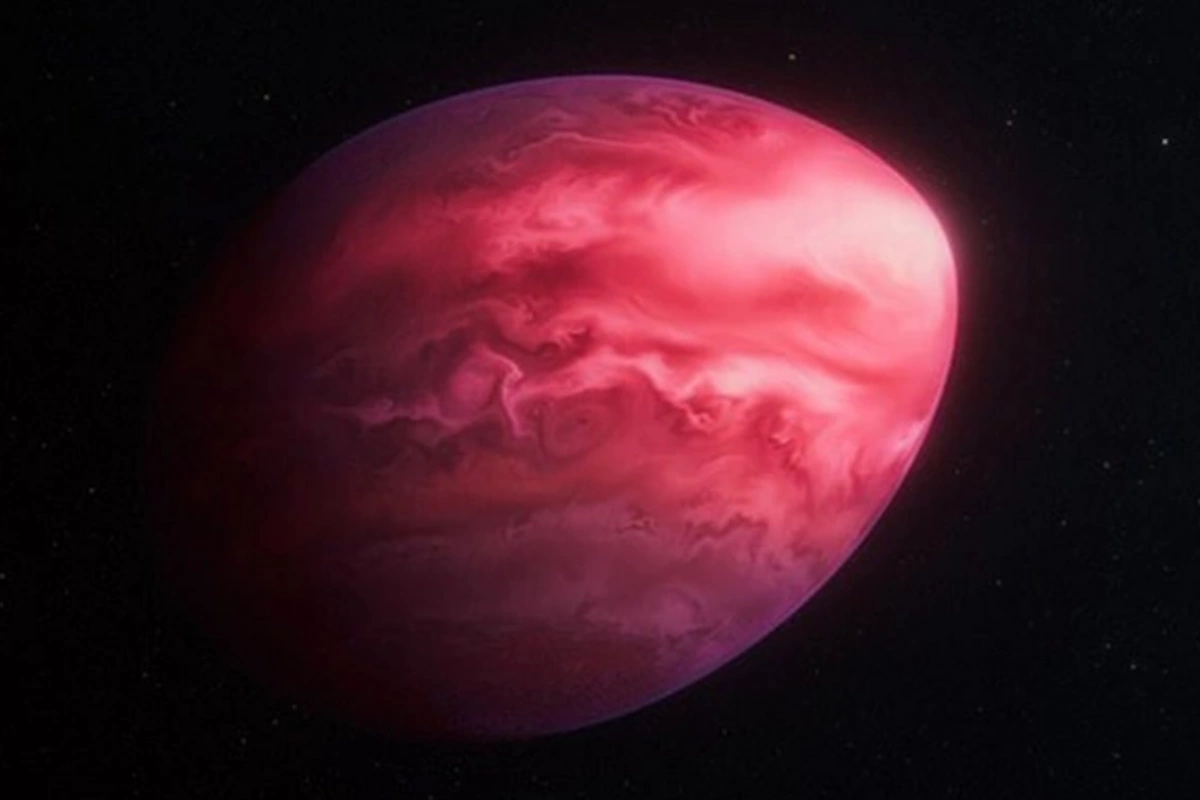
Lemon-shaped planet with unique atmosphere discovered: unexplainable finding has puzzled scientists
Astronomers have discovered an exoplanet of such unusual shape and composition that it completely contradicts existing theories of planetary body formation, reports Daily Mail. The gas giant PSR J2322–2650b, detected by the James Webb space telescope, has caused a real stir in scientific circles.
In size, the mysterious object is comparable to Jupiter, but its physical properties are radically different from anything scientists have encountered before. Under the influence of tremendous gravity, the planet has deformed, acquiring an elongated shape resembling a lemon. Researchers believe that such distortion is caused by the colossal gravitational influence of the parent star.
Unlike most known exoplanets, PSR J2322–2650b orbits not around an ordinary star, but around a pulsar - a neutron star. This cosmic object has a mass comparable to the sun's, but compressed to the size of a large metropolis. The unusual planet is located about 750 light years from Earth and is positioned at a critically small distance from its pulsar - just 1.6 million kilometers.
Due to its extreme proximity to the star, the planet is constantly bombarded with powerful radiation, including deadly gamma rays. A complete orbit around the pulsar takes only about 7.8 hours.
Scientists were particularly amazed by the chemical composition of the celestial body's atmosphere. The telescope detected the presence of molecular carbon with an almost complete absence of water, methane, and carbon dioxide. Dr. Michael Zhang from the University of Chicago emphasizes that this type of atmosphere has never been observed before in any of the studied exoplanets.
PSR J2322–2650b is also the only known gas giant orbiting a neutron star. This makes it an exceptional object of study, since such stars usually either tear apart neighboring objects with gravity or evaporate them with intense radiation.
The origin of the planet remains a mystery. Researchers claim that it could not have formed either through the standard scenario of planet formation or as a result of stellar destruction. None of the known mechanisms explains such an anomalous carbon enrichment.
One of the proposed hypotheses suggests that as the planet cooled, carbon and oxygen could have crystallized inside it, after which pure carbon crystals rose to the upper atmospheric layers and mixed with helium. However, this theory does not explain the absence of nitrogen and oxygen in the atmosphere.