




20 Oct , 21:14
0
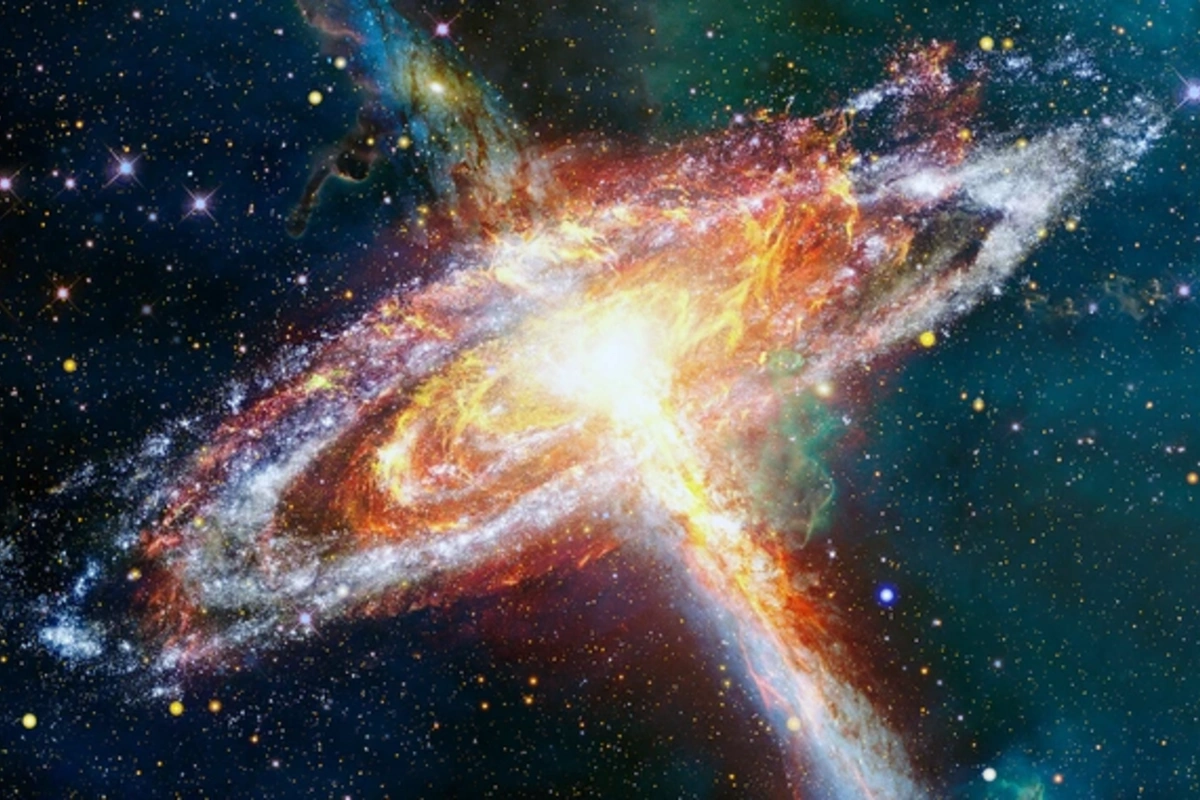
Matter defeated antimatter thanks to a heavy neutrino that physicists had considered an insignificant detail for decades. Due to its slow decay, this particle survived in the cooling cosmos and temporarily seized dominance over the Universe. This is the conclusion reached by a team from the University of Southampton in England together with colleagues. The results of the study have been published in the journal Physical Review Letters.
The problem they are addressing is as old as cosmology itself. According to textbooks, the Big Bang should have produced matter and antimatter in absolutely equal proportions, and upon meeting, they should have been completely converted into radiation. This means the Universe would have turned into a boundless ocean of pure light — without planets, stars, or people. Since we exist, the balance broke down somewhere. By a widely accepted estimate, the imbalance was minuscule: roughly one extra particle of matter per billion annihilated pairs. It was this tiny remainder that assembled all the galaxies known to us.
The answer was found in a particle with a reputation as a bit player — the so-called "decoupled" heavy neutrino, one so weakly interacting with the rest of the world that most previous theories simply ignored it. "This particle was long dismissed as an inconsequential detail in particle physics," explains Rishav Roshan from Southampton. "But because it decays very slowly, it survived the cooling of the cosmos, temporarily captured the energy density of the Universe, and triggered an era of matter domination."
The heavy neutrino shifted the temperature at which leptons — electrons, for example — interacted with their antiparticles through the Higgs boson. It is precisely this temperature that determines how strongly the balance tips toward matter. A tiny shift in the threshold in the early Universe — and here is the result: galaxies, stars, and life itself.
Space itself will allow the hypothesis to be tested: the predicted changes should leave distinct, though barely perceptible, imprints on primordial gravitational waves — the echo of the first moments of the world. The work, according to co-author Sudipta Shaw, changes the picture of the rapid early expansion of the Universe and offers "a new explanation for how matter won." If this imprint is detected, the particle will transform from background noise into the central figure of cosmic genesis, and the question of why we exist at all will receive the most direct answer possible.