







10 Oct , 17:37
0
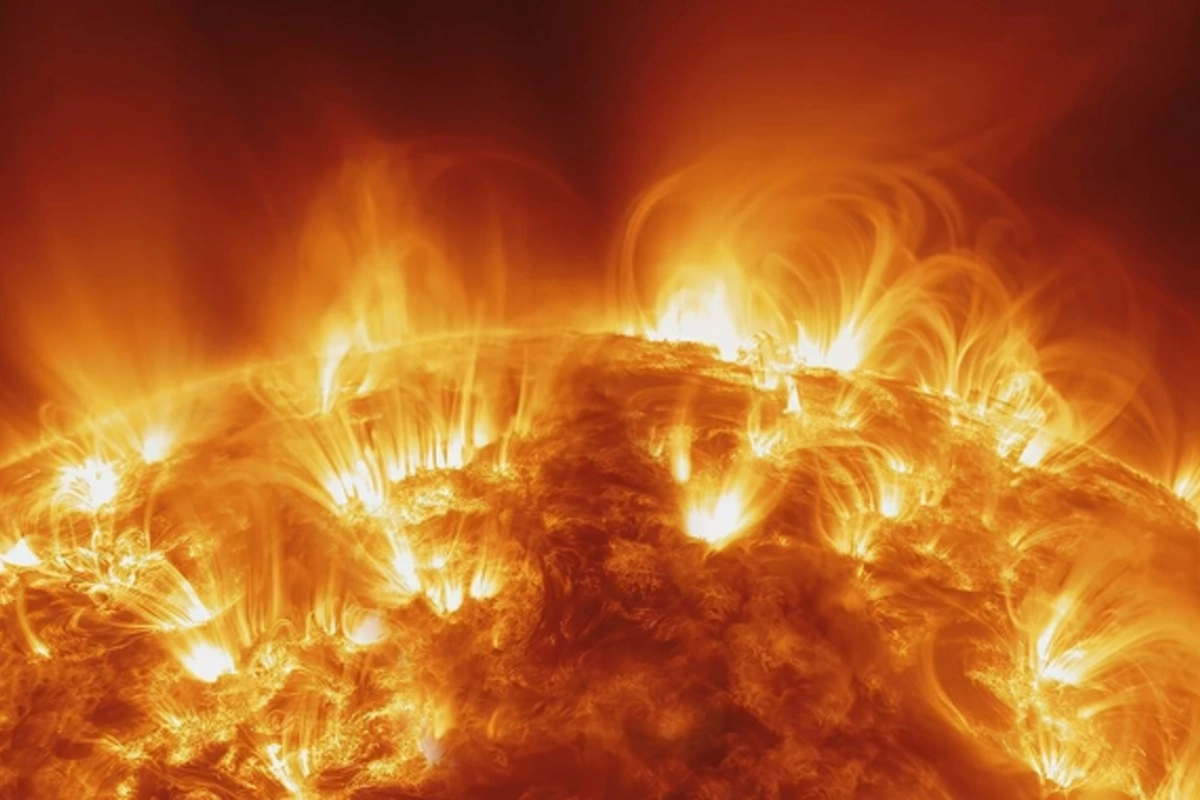
Researchers from University College London have used the Solar Orbiter probe to uncover the mystery behind the birth of magnetic switchbacks — enigmatic structures in the stream of charged particles flying from the Sun. The results of the study have been published in the journal Nature Astronomy.
The Sun continuously ejects solar wind into space — a powerful stream of charged particles threaded with magnetic field lines. From time to time, these lines sharply bend back toward the star, forming so-called magnetic switchbacks. For years, scientists were unable to determine exactly where these anomalies originate. Now the mystery has been solved: it turns out that these structures carry unique "fingerprints" of the solar surface, making it possible to trace their origin.
By analyzing the chemical composition of particles inside one such switchback, the team detected an anomalously high ratio of oxygen to carbon ions against a backdrop of noticeably reduced helium content. This "signature" unambiguously indicated that the material had escaped from superheated closed magnetic loops in the corona — the outer layer of the solar atmosphere. The mechanism turned out to be as follows: closed magnetic loops collided with open field lines, reconnection occurred, and superheated plasma was ejected into space.
In astrophysics, there has long been a debate about two key processes capable of heating the solar atmosphere and accelerating the wind: magnetic reconnection on one hand, and waves with turbulence on the other. Studying magnetic switchbacks allowed scientists to unite both concepts. It was found that reconnection is responsible for the birth of these structures, while wave processes are responsible for their subsequent propagation through space.
The discovery demonstrates that magnetic field switchbacks are not random glitches at all, but rather distinctive "messages" from the Sun. They carry valuable information about the physical processes that heat the stellar atmosphere and accelerate the solar wind. In the future, deciphering such messages will help physicists predict space weather far more accurately — weather that directly affects the operation of satellites and electronics on Earth.