




07 Aug , 09:57
0
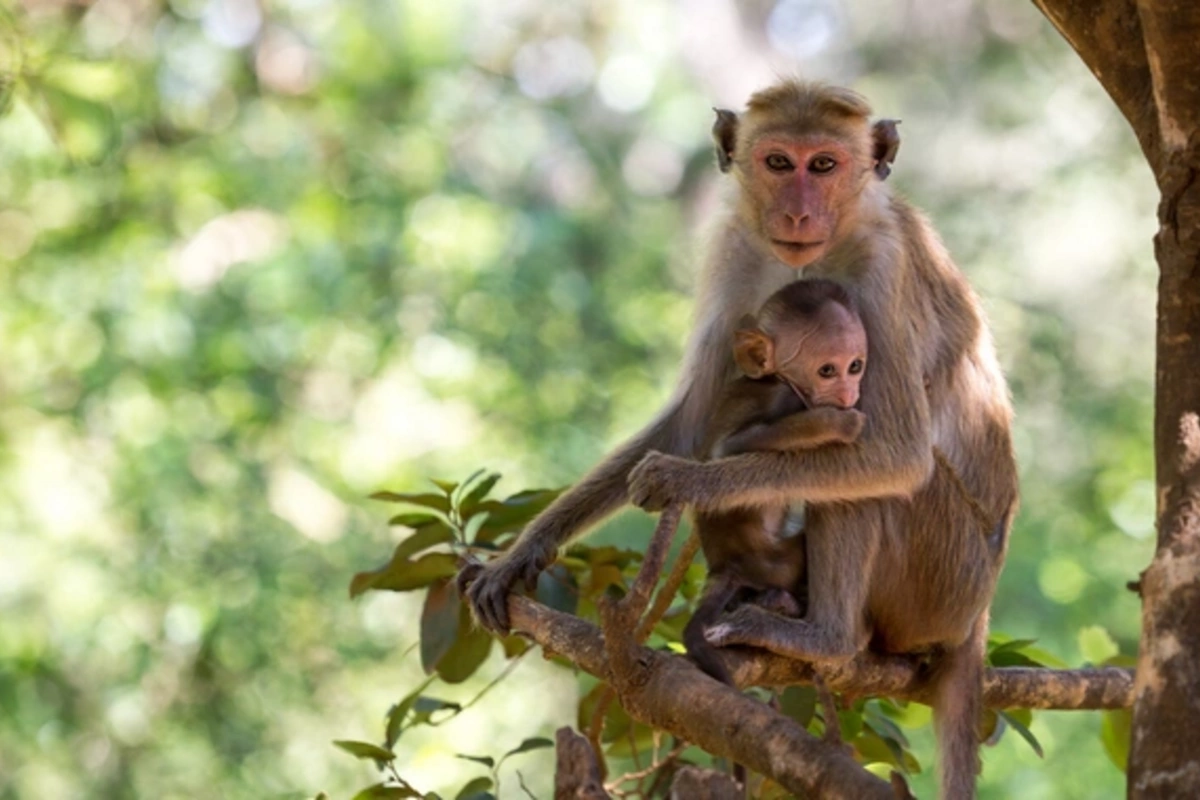
Macaques, like humans, associate rounded shapes with the sound of the word "bouba" and angular shapes with the word "kiki." Scientists reached this conclusion through an original experiment, the results of which were published on the bioRxiv portal.
The famous "bouba-kiki" effect was first described back in the 1920s: the overwhelming majority of people, regardless of their native language and alphabet, call an angular figure "kiki" and a rounded one "bouba." Now it has been discovered that monkeys build similar associations. Nine macaques from the Mandai Wildlife Reserve in Singapore participated in the experiment — eight long-tailed macaques and one pig-tailed macaque.
During the preparatory phase, the animals were trained without any audio accompaniment to search for food under a lid featuring a hybrid figure — half rounded, half angular. Then the main phase began: each monkey was offered a choice of two lids — one with a rounded and one with an angular figure — while a repeated recording of the word "bouba" or "kiki" played. Each animal underwent 24 trials in short blocks of three, with the placement of the figures and the sound played alternating to eliminate systematic bias.
The results of the experiment turned out to be strikingly similar to data from analogous tests on humans: the macaques noticeably more often chose the lid with the rounded figure when "bouba" was played, and the angular one when "kiki" was played. Statistical analysis showed that the odds of choosing the rounded figure when "bouba" was played were nearly six times higher than when "kiki" was played. The authors emphasize that studies with a larger number of animals are needed for more robust conclusions. Nevertheless, the obtained result is the first serious indication that the associations underlying language may be rooted in something shared between humans and other primates.
"These findings shift the evolutionary question from whether the effect is unique to humans to how broadly such perceptual mappings are distributed among vertebrates," the preprint authors noted.