





25 Dec , 13:17 2025
6
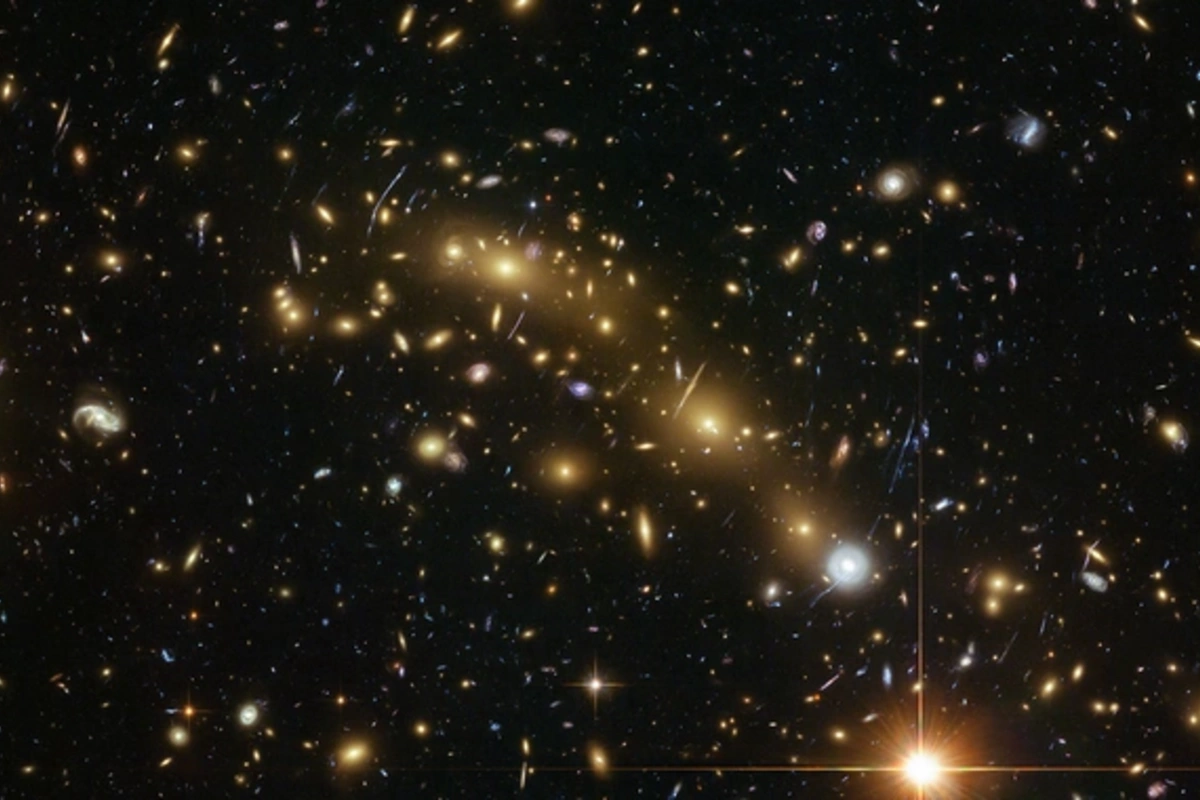
Scientists have discovered a "cosmic anomaly" capable of overturning our understanding of the Universe. An international research group has revealed that the so-called "cosmic dipole anomaly" calls into question the fundamental principle of modern cosmology about the uniformity of the Universe in all directions.
The standard model of cosmology (ΛCDM) is built on the assumption that the Universe is generally homogeneous and isotropic, meaning it has the same properties regardless of the direction of observation. This concept was supported by data on cosmic microwave background radiation — the oldest light in the Universe left over from the Big Bang, which is indeed distributed almost evenly across the sky.
However, there is a noticeable asymmetry in this radiation — a dipole: one region of the sky appears somewhat "warmer," while the opposite one is "colder." This effect by itself is explained by the movement of our Solar System and does not contradict the existing theory. Difficulties arise when attempting to detect a similar dipole in the distribution of material objects — galaxies and quasars in the Universe.
Back in the 1980s, scientists proposed an important cosmological test: if the standard model is correct, the dipole in the distribution of cosmic matter should exactly correspond to the dipole of cosmic microwave background radiation. Current observations, however, show a discrepancy: the directions of the dipoles coincide, but their magnitudes differ significantly.
"We have found that the Universe does not pass the so-called Ellis-Baldwin test. The matter dipole does not correspond to the cosmic microwave background dipole," the authors of the work noted.
According to them, this discrepancy is confirmed by different data sets - both ground-based radio telescopes and space observations in the infrared range, which reduces the likelihood of systematic error.
Unlike the better-known "Hubble tension," associated with different estimates of the rate of expansion of the Universe, the cosmic dipole anomaly affects the very foundation of the cosmological model.
"This problem cannot be fixed with simple corrections. It may require abandoning the standard description of the Universe and revising basic assumptions," the researchers emphasized.
In the coming years, an avalanche of new data from next-generation missions and telescopes is expected. Scientists have not ruled out that machine learning methods may play a key role in the search for a new cosmological model.
If the findings are confirmed, this could lead to a radical revision of our understanding of the structure and evolution of the Universe.