





25 Dec , 13:59 2025
7
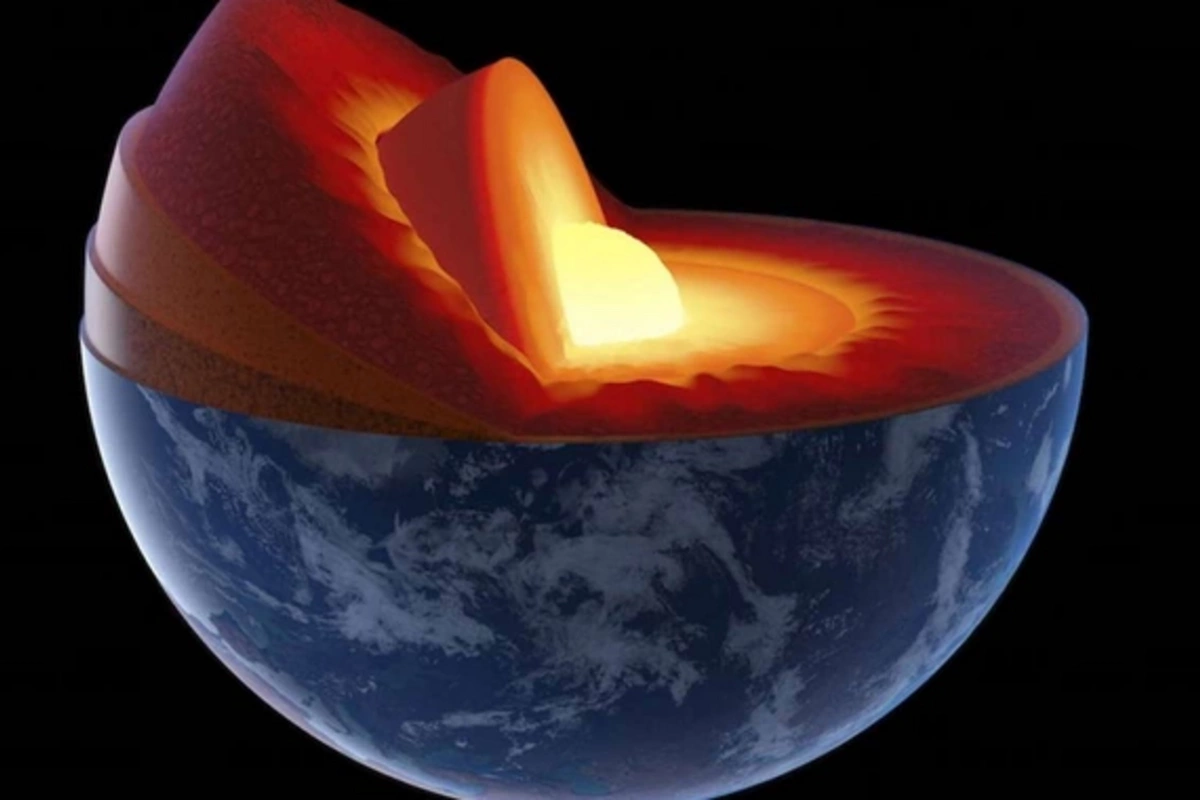
Scientists uncovered the secret of "thermal insulation blankets" in the depths of Earth: how ultra-low velocity zones influence the planet's magnetic field
As TUT.AZ reports, the work was published in the journal Nature Communications (NatCom).
ULVZs are small-sized areas (tens of kilometers in height and about a hundred kilometers in width), "stitched" to the base of the mantle. Seismologists have long known that seismic waves propagate noticeably slower in them, and the density of matter is higher than in the surrounding rocks. However, their real impact on Earth's evolution remained unclear.
A team led by Wen-Pin Hsieh from the National Taiwan University directly measured for the first time the thermal conductivity of iron-rich magnesiowüstite - a mineral considered the main candidate for the composition of ULVZs. The experiments were conducted using diamond anvils at extreme pressures and temperatures.
It turned out that the thermal conductivity of this material is abnormally low - significantly lower than that of the surrounding mantle rocks. According to the scientists' calculations, this causes ULVZs to behave as local "thermal insulation blankets," hindering the outflow of heat from the core.
"Such zones can significantly change the distribution of heat flow at the core-mantle boundary and even cause local thermal stratification in the upper part of the core," explained Wen-Pin Hsieh. According to him, this is directly related to the energy balance of the geodynamo and, consequently, to the evolution of Earth's magnetic field.
The authors emphasize that the study only partially lifts the veil over processes in the deep interior of the planet. "We still know very little about how Earth's internal 'engine' works - and there's still a lot of work ahead," the scientist noted.
The results help to better understand how small-scale structures in the interior can influence global processes - from the thermal history of the planet to the stability of its magnetic shield.