






10 Oct , 09:38
0
Scientists from Earlham Institute and the University of Oxford have discovered a microorganism in an ordinary pond that has broken one of the fundamental rules of genetics by rewriting the meaning of "stop signals" in DNA. The results of this unique study have been published in the journal PLOS Genetics.
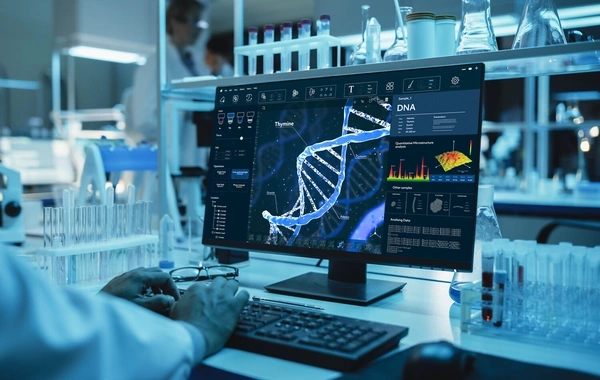
The genetic code is commonly compared to an instruction manual for assembling a protein. It contains three special combinations of "letters" — stop codons — that act as a command: "The protein is complete, there is nothing more to build." This principle had been considered an unshakable law for all life on the planet for decades. However, the discovered ciliate has called this dogma into question: in its DNA, two such signals unexpectedly acquired an entirely different meaning. Instead of stopping, they began to indicate specific amino acids — the building blocks of protein. In other words, where the cell should have commanded "stop," it imperturbably continued reading the instructions further.
The subject of the study was a microscopic organism of the species Oligohymenophorea sp. PL0344, which specialists had initially collected solely to test a new method of reading DNA from a single cell. The scientists were astonished to discover that this creature had only one functioning "stop signal" remaining, while the other two had ceased to halt protein synthesis and had begun encoding amino acids. This task was taken on by special translator molecules — they recognize the code and insert the appropriate building block.
"This shows how little we know about protist genetics and how much more flexible life is than textbooks suggest," noted researcher Dr. Jamie McGowan.
Historically, science has made discoveries by relying on organisms that are easy to cultivate in the laboratory. The discovered ciliate categorically refused to survive under laboratory conditions; however, new DNA reading technology made it possible to conduct analysis directly on material from the natural environment. Soon, similar genetic anomalies were identified in marine microorganisms from Arctic waters. This served as evidence that evolution is rewriting the basic vocabulary of life in far more than just one unique place on Earth.
Understanding how a cell manages to safely change the meaning of "periods" in DNA could in the future help bioengineers create artificial organisms with similar properties.